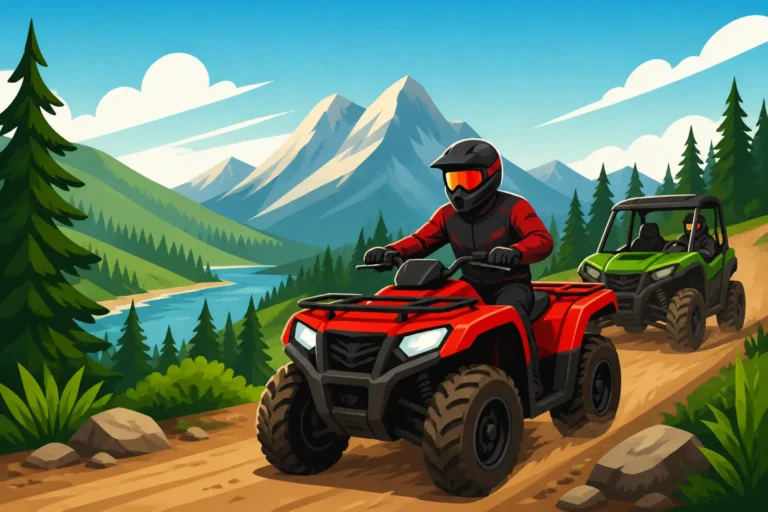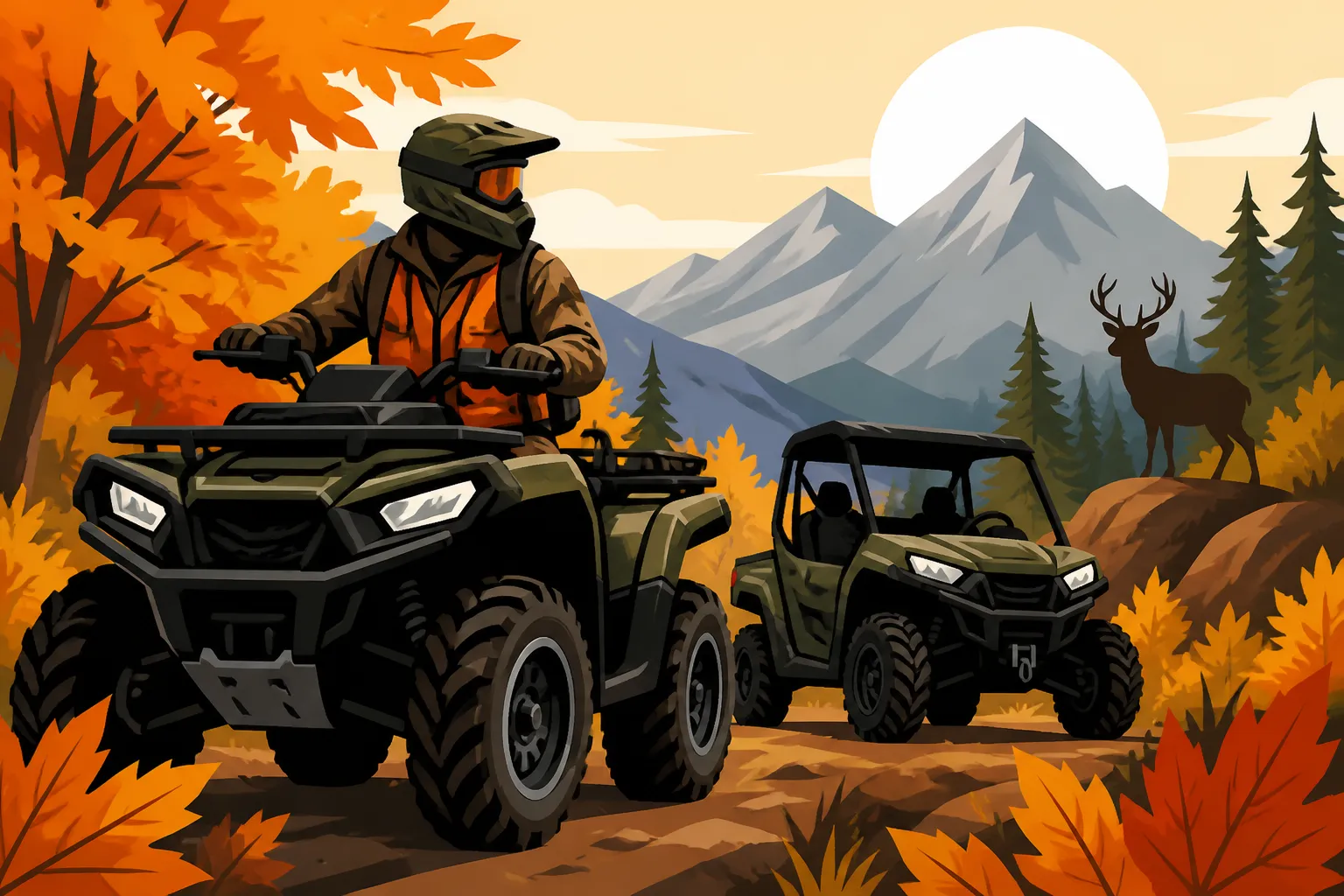
BC Riding in Fall Hunting Season
Fall riding in British Columbia can mean crisp trails, quieter campsites and beautiful views—but it also overlaps with hunting seasons, when access rules and safety concerns can change by area. The key is not to assume a trail is open just because you rode it in summer. This guide explains how to check closures, plan a considerate route and share the backcountry safely.
How hunting season can affect ATV and UTV access in BC
Hunting season does not automatically close every trail
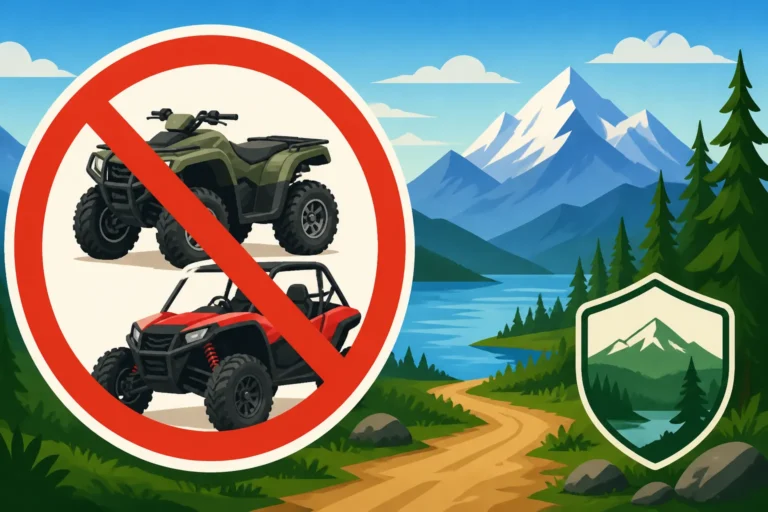
Hunters and ATV or UTV riders may use the same backcountry roads and trails. The start of a hunting season does not, by itself, mean all motorized riding in the area is prohibited. What matters is whether a specific closure or restriction applies to the location, dates and type of vehicle you plan to use.
Some restrictions are tied to particular places or periods, including areas where vehicle use is limited to help manage wildlife or protect habitat. A route can also be affected by a park rule, a posted restriction, a fire-related closure or a road that is closed for industrial activity. Check the conditions for the exact area rather than relying on a general statement such as “hunting season is open” or “the trail is usually fine.”
The [BC Hunting Closed Areas for Vehicles] resource is a useful starting point for understanding why hunting-related restrictions may affect vehicle access. For a more practical overview of what to look for, see [Closures Published for Hunters] and [BC Trail Closures in the Hunting Synopsis]. Treat these as prompts to investigate the current rules—not as a substitute for checking whether a particular route remains open.
Check the route, dates and vehicle restrictions together
Before you ride, identify your planned route on a map and check each part of it against current closure information. A route may cross more than one management area, and the rules can change along the way. Pay attention to the precise boundaries, dates and vehicle types named in a notice. A closure may cover a specific road or zone rather than every trail in a region.
This is especially important if you are riding near places with several access options. The broader areas around the Okanagan, the Cariboo, the Kootenays, the Chilliwack Valley and Vancouver Island each contain different roads, recreation sites and land-management boundaries. Do not assume a rule you checked for one trailhead applies to another nearby route.
Mapping tools can help you plan and keep track of your intended route. For example, some riders use onX Offroad to review routes as part of trip planning, then compare what they see with official closure notices and signs on the ground. A map app should not be treated as proof that a route is legally open; posted closures and official information take priority.
Look beyond hunting-related closures
A route that is not closed for hunting may still be unavailable for another reason. Before heading out, check for motor vehicle closures, active logging, fire restrictions, damaged roads, seasonal access limits and restrictions in parks or other protected areas. A gate, sign or fresh closure notice can matter even if a trail appeared open on an older map.
Use [BC Motor Vehicle Closures and How to Find Them] to understand the broader closure-checking process, and review [BC Crown Land Riding Explained] if you are unsure what public land status does—and does not—mean for access. Crown land is not a blanket invitation to ride anywhere. Access can still be restricted, and permission may be needed for private land or land held under lease.
Plan a fall ride that accounts for hunters and conditions
Start with a route you can explain to someone else
Fall days are shorter, the weather can turn quickly, and some backcountry areas have limited cell coverage. Before leaving, write down your route, expected turnaround time and backup option. Share those details with someone who is not on the ride. If plans change, let them know when you regain service or return.
Check the route’s access points and make sure your vehicle and trailer can reach the staging area. A trail that is manageable on an ATV may be difficult to navigate with a long trailer, especially on narrow roads or during wet conditions. If you are unfamiliar with the area, avoid making a complex route plan that depends on finding an unmarked cut-off in poor light.
Tools such as onX Offroad can help you organize a route and keep a planned track visible while preparing. Still, download or save what you need before leaving service, carry a paper backup if it is practical, and confirm important restrictions through official sources. Do not rely on a phone screen as your only navigation plan in remote country.
Expect changing trail and road conditions
Autumn can bring rain, mud, frost, early snow and fallen branches. A firm road in September may become slippery or rutted after a storm. In higher-elevation areas, a sunny valley forecast does not guarantee safe conditions on an exposed ridge. Check the forecast for the elevation and region you will actually ride, and be willing to shorten the trip if conditions deteriorate.
Pack layers, waterproof outerwear, gloves, food, water, a first-aid kit and a way to communicate when there is no cell signal. On longer remote rides, consider carrying a satellite messenger and enough fuel for a return trip with a margin. A map, compass and basic vehicle-recovery equipment are sensible additions when you are travelling beyond well-used corridors.
Make the machine ready for the conditions as well. Check tires, brakes, lights, belts, battery, winch and recovery points before departure. Secure loose cargo so it cannot shift or obscure the plate. If rain or mud makes the route unsafe, turn around early rather than pushing farther in the hope that the next section will be better. For seasonal route ideas and preparation, [BC Riding in Fall Hunting Season] connects with broader planning topics such as [BC Wildlife on the Trail].
Build in time for industrial traffic
Many backcountry routes are also working roads. On a resource road, you may encounter logging trucks, pickup trucks, service vehicles or other industrial traffic. A quiet stretch can become busy without much warning, especially around active work sites. Watch for signs, follow posted instructions and do not assume that a road is recreational simply because it is used by riders.
If radio procedures apply on your route, learn them before setting out. [BC Resource Road Radio Practice] covers why communication and awareness matter when sharing roads with industrial users. Where you do not have a radio, ride conservatively, keep to a predictable line and be ready to yield. Avoid stopping around blind corners or in places where a larger vehicle cannot see you in time.
Share the backcountry safely during hunting season
Make your machine and riding group easy to notice
Visibility is a practical safety choice in the fall. Use bright clothing or a high-visibility vest, keep required lights in working order and avoid blending into brush when stopping beside a trail. Check your machine’s lighting before the ride, especially if you might be out near dusk. Carry a flashlight or headlamp for unexpected delays.
Ride with a group when possible, and agree on how to regroup if someone gets separated. Keep enough space between machines to avoid dust, debris and sudden braking problems. At intersections, stop where you can be seen, check for traffic and make sure the whole group understands which route you are taking. If a trail is narrow, pass slowly and courteously rather than forcing another user off the track.
Visibility is not a substitute for checking the rules or using good judgment. It simply gives other people a better chance of noticing you. If you come across hunters preparing to leave a road or trail, slow down, give them room and avoid creating unnecessary noise or dust near their equipment or camp.
Give hunters space and avoid disturbing wildlife
When you encounter hunters, a calm and respectful interaction helps everyone share the area. Slow well before reaching them, make your presence known without startling anyone, and ask whether they need space to move equipment or cross the route. Do not drive toward a person who is handling a firearm or near a field dressing site. If the situation feels unclear, turn around or choose another route.
Keep a generous distance from wildlife. Do not chase animals, crowd them for a photograph or ride off established routes to get closer. Fall is a demanding period for many animals, and extra stress or displacement can cause harm. It is also a poor time to assume that an animal is habituated to vehicles simply because it does not immediately run away.
Good trail manners matter outside hunting season too. The guidance in [BC Trail Etiquette Locals Expect] is relevant when sharing routes with hunters, hikers, campers and other riders. Keep noise reasonable, pack out your garbage and leave gates as you found them unless signs say otherwise.
Know when to stop, turn around or report a problem
If you see a closure sign, gate or official notice, stop and follow it. Do not ride around a barrier, squeeze past a gate or assume that a closed road is open because another rider has gone through. A closure may protect people working in the area, wildlife, property or a section of damaged trail. Find another route instead of risking an unsafe or prohibited entry.
You should also turn around if the road is deteriorating, visibility is poor, weather is worsening or the group is running short on daylight. A planned destination is not worth a rollover, a stranded machine or a late-night return on an unfamiliar road. Agree on a turnaround time before leaving so the decision does not become an argument when everyone is tired.
If you find a blocked trail, damaged bridge, active work zone or sign that appears to conflict with your route information, do not move barriers or try to resolve the problem yourself. Record the location if it is safe to do so and contact the appropriate land manager or authority. Your notes can help clarify the situation for future users.
A practical pre-ride checklist for fall
Use this checklist the day before your ride and again before unloading at the trailhead.
| Check | What to confirm |
|---|---|
| Route | Identify the roads, trails, access points and a backup route |
| Hunting-related rules | Check the hunting synopsis and any area-specific vehicle restrictions |
| Other closures | Look for park rules, motor vehicle closures, fire restrictions and posted signs |
| Road use | Check for active logging, industrial traffic or other access notices |
| Weather | Review conditions for the route’s elevation and allow for rain, frost or early snow |
| Navigation | Save maps or route details offline and carry a backup |
| Group plan | Share the route and return time with someone who is not riding |
| Machine | Check tires, brakes, lights, fuel, battery and recovery equipment |
| Visibility | Wear noticeable clothing and make sure the machine’s lights work |
| Supplies | Carry water, food, layers, first aid and a communication option for dead zones |
| Courtesy | Slow near other users, give hunters space and stay on routes you are allowed to use |
If you are specifically planning a ride during rifle season, read [Riding a BC Trail During Rifle Season] alongside the closure information for your chosen area. A little extra checking can save a long drive to a closed trailhead—and help prevent a day in the backcountry from becoming stressful for you or anyone else.
Disclaimer
This article is for general informational purposes only and does not constitute professional advice. Laws, prices and regulations vary by location and change over time. Consult a qualified professional for guidance on your specific situation.