BC Lighting Rules in Low Visibility
It's easy to think your ATV or UTV lights are just for night riding, but here in British Columbia, the rules around "low visibility" can catch even experienced riders off guard. Whether you’re an early bird hitting the trails at dawn, caught in a sudden downpour, or navigating a misty forest, knowing your lighting requirements isn't just about avoiding a ticket – it's about staying safe and seen. This guide will illuminate exactly when and what kind of lighting your off-road machine needs to comply with BC's regulations.
The Core BC Lighting Requirements for ORVs
The Off-Road Vehicle Act and its associated regulations are pretty clear that proper lighting isn't just a suggestion; it's a mandatory safety feature. It’s not simply a matter of dark vs. light, but rather a spectrum of conditions where visibility becomes compromised. Understanding these core requirements is the first step to ensuring you're always riding legally and safely.
When "Low Visibility" Actually Kicks In
"Low visibility" isn't just limited to the dead of night. In BC, this term covers a surprising range of conditions that can drastically reduce how well you can see and be seen. Think about those beautiful, misty mornings in the Fraser Valley when the fog rolls in thick and fast, or a sudden, torrential downpour that turns the clearest day into a grey blur in the Cariboo backcountry. Even just before sunrise or after sunset, when the natural light is fading but it's not yet fully dark, counts as low visibility.
Consider a late autumn ride through a heavily treed section of Crown land. Even at midday, dense forest canopy can create dim, almost twilight conditions where your visibility, and more importantly, the visibility of other trail users or even wildlife, is severely reduced. The law doesn't specify a precise lux level; instead, it relies on a common-sense understanding of when it's harder to see clearly. If you find yourself squinting, or if you can't easily make out details more than a few dozen metres away, it's likely time to switch on your lights. Being proactive here is key to avoiding an unexpected encounter or a visit from an enforcement officer.
The Basic Front and Rear Lamp Rules
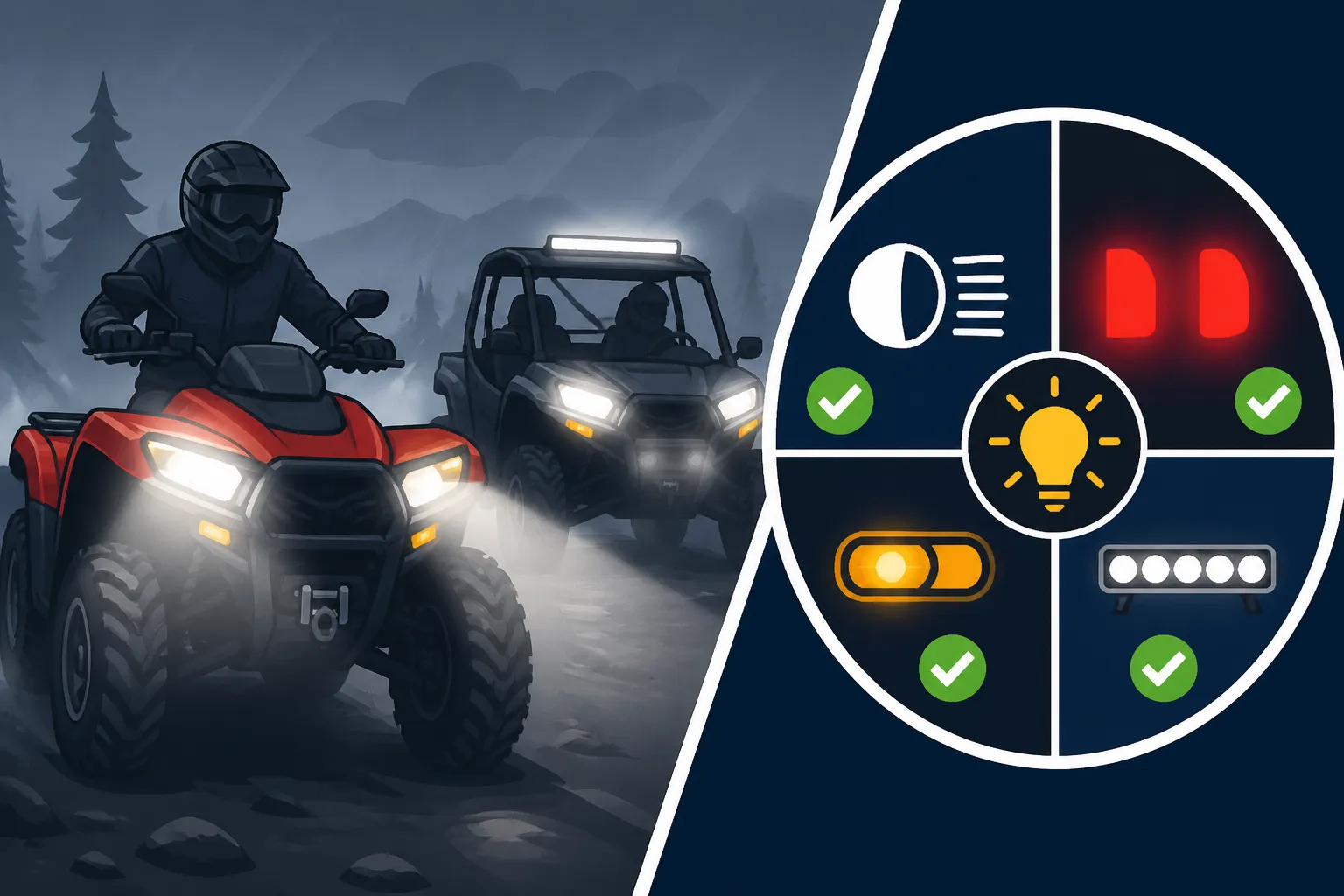
At its heart, the BC Off-Road Vehicle Act requires every off-road vehicle operated in low visibility to be equipped with at least one headlight and at least one taillight. These aren't just decorative elements; they need to be functional and visible from specific distances. Your headlight, whether it’s a single unit or a pair, must be capable of illuminating objects at least 60 metres (roughly 200 feet) ahead of your machine. This isn’t a trivial requirement; it’s designed to give you enough reaction time to see obstacles, wildlife, or other trail users on varied terrain.
The taillight also has a critical job: making you visible to anyone approaching from behind. It must emit a red light visible from a distance of at least 150 metres (about 500 feet). This is especially important on shared trails, forest service roads, or when riding in groups where dust can obscure vision. It’s also important to note that these lights must be fully operational and properly aimed. A headlight pointed at the sky or a taillight caked in mud won't cut it, and could easily lead to a discussion with a conservation officer or RCMP. Don't forget, these basic requirements apply whether you're riding a quad, a dirt bike, a snowmobile, or a side-by-side.
Why Your Machine Needs Reflectors Too
Beyond active lighting, passive visibility is also mandated, especially when it comes to reflectors. Every ORV operated in low visibility must be equipped with at least one red reflector at the rear. This reflector needs to be mounted in such a way that it's visible from a distance of at least 150 metres (500 feet) when illuminated by the headlamps of another vehicle. Think of it as a last line of defense for visibility. If your taillight fails for some reason – perhaps a bulb burns out, or a wire gets snagged on a branch – that reflector is still there, catching light and making your machine discernible.
While the primary requirement is for a rear red reflector, many machines also come equipped with side reflectors, typically amber, or front reflectors, often clear or amber. These additional reflectors, while not strictly mandated in the same way as the rear red one, significantly enhance your machine’s profile from various angles. If you’ve ever had to stop your machine on the side of a narrow trail or resource road for a quick repair, you’ll appreciate how much these small, inexpensive safety features contribute to preventing potential collisions, especially with traffic moving in the opposite direction or with other riders. Manufacturers like Polaris and Can-Am typically include these on their stock machines, but if you've done any custom work or had a spill, it's worth a quick check to ensure they're still in place and clean.
Specific Equipment for Low Light and Night Riding
Meeting the basic requirements is a good start, but understanding the specific types of lighting and their functions is crucial for optimal safety and compliance. When the sun dips below the horizon, or when thick fog rolls in, your lighting system becomes your most critical piece of safety gear, even more so than just during those "low visibility" conditions.
Headlights: More Than Just "Being Seen"
Your headlights do double duty: they help you see where you're going, and they help others see you. The 60-metre illumination requirement for your headlights is a minimum, and many experienced riders find that stock headlights, especially on older machines, often don't cut it for serious night riding or challenging low-light conditions. You're trying to spot potholes, fallen trees, wildlife, and sudden drops in terrain, sometimes at speed. A dim, yellowing beam just won't give you the reaction time you need, particularly on unfamiliar trails.
Many riders opt for aftermarket upgrades to enhance their forward illumination. Modern LED light bars and auxiliary lamps, often available from retailers like SuperATV, offer significantly brighter, whiter light with much broader coverage patterns. These can transform your night riding experience, making it safer and more enjoyable. However, be mindful of beam patterns and aiming. A light bar that blinds oncoming trail users is just as dangerous as not having enough light. Always aim your lights properly to illuminate the path without creating glare for others. Carrying extra batteries for any auxiliary LED lights is also a smart move if they are independently powered, ensuring you don't get stuck in the dark if your machine's primary electrical system encounters an issue.
Taillights and Brake Lights: Critical for Safety
While your headlights are about what's ahead, your taillights and brake lights are all about what's behind you. The single red taillight visible from 150 metres is a non-negotiable minimum. But just as important are your brake lights. When you slow down or stop, especially unexpectedly, those bright red signals are your primary way of communicating your actions to riders following behind. On a dusty forest service road, a sudden stop without clear brake lights could lead to a chain reaction.
It's common for off-road vehicles to have integrated taillight/brake light assemblies. Always ensure both functions are working. Have a friend stand behind you and check when you apply the brakes. Dust, mud, and water can wreak havoc on electrical connections and bulb filaments over time. If you're a serious rider, consider upgrading to brighter LED taillight and brake light units. Not only do they draw less power from your machine's electrical system, but they are also typically more durable and significantly brighter, giving following riders a clearer signal of your intentions. This is especially vital when riding on [BC Forest Service Road Requirements] where you might encounter industrial traffic or faster-moving vehicles.
The Unexpected Role of Bicycle Lights
Here’s a detail that often surprises people: if your ORV isn't originally equipped with the required lighting, or if your lights fail during a ride, the BC regulations actually allow for a specific, temporary solution. You can use a bicycle lamp that emits a white light visible from 150 metres (500 feet) to the front, and a bicycle lamp that emits a red light visible from 150 metres (500 feet) to the rear. This seems a bit unconventional for a powerful ATV or UTV, but it speaks to the emphasis on simply being seen when factory lights aren't an option.
This isn't an excuse to ride indefinitely with bicycle lights as your primary setup, but rather a last-resort safety measure. Imagine you're deep in the Kootenays, your headlight bulb just blew, and dusk is setting in fast. Having a small, battery-operated bicycle light in your toolkit could literally be a lifesaver, allowing you to safely make it back to your truck or camp. Always carry spare batteries for these, or ensure they're USB-rechargeable with a power bank. While certainly not ideal for illuminating the trail in front of you, they fulfill the fundamental legal requirement of making your presence known to others. Think of it as a bare minimum to avoid being a ghost in the dark.
Beyond the Basics: Practical Considerations and Enforcement
Understanding the letter of the law is one thing, but applying it practically on the trails of BC, where conditions can change on a dime, is another. Being prepared for varying visibility conditions, properly maintaining your equipment, and knowing the consequences of non-compliance are all part of responsible ORV operation.
Visibility in Fog, Dust, and Heavy Rain
Riding in less-than-ideal weather is a common occurrence for many BC enthusiasts, but these conditions amplify the need for proper lighting. Fog, whether it's a coastal sea fog rolling up a valley or high-altitude mist in the mountains, can make even the brightest lights seem dull. In these situations, low-mounted fog lights can sometimes be more effective than main headlights, as they project light under the fog rather than reflecting it back into your eyes. Similarly, riding on dry trails during summer can kick up incredible amounts of dust, especially in groups. Your taillights, reflectors, and even auxiliary dust lights (often amber) become critical for the safety of those behind you.
Heavy rain, particularly on unpaved surfaces, reduces visibility dramatically and can cause significant glare. Your lights help cut through the spray and reflection, making your machine more visible to other trail users and helping you delineate the path ahead. Always ensure your light housings are sealed against moisture. Aftermarket lights from brands like SuperATV often boast high IP (Ingress Protection) ratings, indicating their resistance to dust and water, which is a huge advantage for BC's varied climate. Remember that low visibility also means you need to see better, so investing in good quality, weather-resistant lighting is a practical safety decision. You may also want to consider [BC Lighting and Seat Belt Requirements] as a complete safety package.
Maintenance and Inspection of Your Lighting System
Your lighting system is only as good as its maintenance. Before every ride, especially if you anticipate low-light conditions, do a quick walk-around and check all your lights. Turn on your machine, activate your headlights, taillights, and brake lights, and physically confirm they are all working. Check for any cracked lenses, loose wiring, or excessive mud buildup. A cracked lens can allow water to ingress and damage the bulb or LED circuitry, while mud on a lens drastically reduces light output.
Bulbs can burn out unexpectedly, and even LED units can fail due to vibrations or electrical shorts. Carrying spare bulbs (if your machine uses incandescent types) or a spare set of portable LED lights is a wise precaution. Regularly clean your light lenses with a mild soap and water solution – avoid harsh abrasives that can scratch the plastic. Pay attention to your machine's electrical system too. A weak battery or corroded terminals can lead to dim lights or intermittent failures. If you notice any flickering or inconsistent light output, it’s a sign to investigate further before your next big ride.
What Happens if You're Caught Without Proper Lighting
Riding without the required lighting during low visibility conditions in BC isn't just risky; it's illegal. Enforcement officers, whether they are RCMP, conservation officers, or bylaw enforcement in certain areas, have the authority to issue tickets for non-compliance. The fines can be substantial, and beyond the financial penalty, you could be deemed a safety hazard and asked to cease operation until the issue is rectified. Imagine being deep in the backcountry and being told you can't ride your machine back to your trailer because your taillight is out. This is a very real scenario.
These rules are part of the broader [What the Off-Road Vehicle Act Covers in BC] and are designed to ensure the safety of all users of Crown land and resource roads. Ignoring these regulations not only puts you at risk but also jeopardizes the safety of other riders, hikers, hunters, and industrial workers you might encounter. If you’re caught, you can expect a violation ticket, and depending on the severity and context, potentially further enforcement actions. It's much simpler, and far cheaper, to perform a quick check before you head out and ensure all your lights are in perfect working order. Don't let a simple oversight turn a great ride into a costly headache.
Disclaimer
This article is for general informational purposes only and does not constitute professional advice. Laws, prices and regulations vary by location and change over time. Consult a qualified professional for guidance on your specific situation.