No Inspection, No Emissions Test
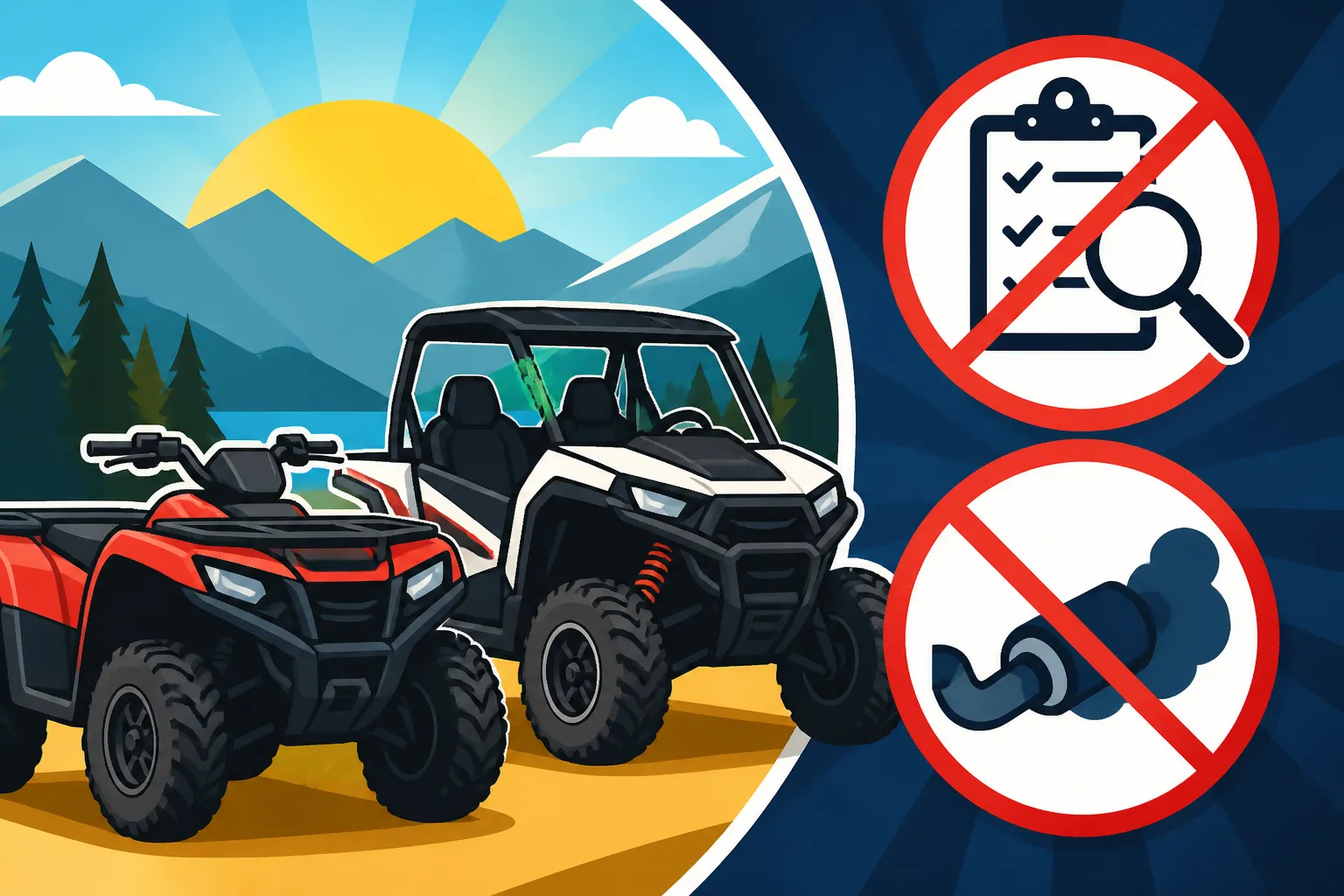
It's a common assumption that when you register any kind of vehicle in British Columbia, you'll be putting it through some sort of mechanical inspection or emissions test. After all, that's often the case for cars and trucks, right? But for your ATV, side-by-side, dirt bike, or snowmobile, you can breathe a sigh of relief: BC's Off-Road Vehicle Act has a different approach, and it doesn't involve your machine heading to a shop for a safety check or a smog test. This guide will walk you through why these tests aren't required, what is needed to get your ORV legally registered, and what this means for you as a rider and owner in our beautiful province.
The Relief of No Inspections for Your BC ORV
Let's be honest, the thought of adding another hoop to jump through, another appointment to book, and another potential bill to pay just to register your off-road vehicle can be a real headache. Many folks come into the ORV registration process bracing themselves for the kind of rigorous mechanical inspections that on-road vehicles sometimes require. They picture their quad on a hoist, mechanics poking and prodding, looking for every little thing that might not pass muster.
Dispelling a Common Misconception
It's a genuine "aha!" moment for many BC riders when they learn that their ATV or UTV doesn't need to pass a mechanical inspection to be registered. This isn't just about avoiding a minor inconvenience; for those of us with older machines, or custom builds, or even just machines that see a lot of hard use on the trails, the idea of a mandatory inspection can be a source of real anxiety. Will that slightly bent tie rod fail it? Will the aftermarket exhaust cause an issue? The good news is, you don't have to worry about these kinds of checks when it comes to getting your ORV legally recognized in BC.
This lack of a mandatory inspection streamlines the registration process significantly. It means you don't need to factor in the time or cost of preparing your machine for an inspection, nor do you need to deal with potential repair costs just to get a sticker of approval. For the busy rider who just wants to get out on the trails, this is a welcome simplification that gets you riding faster and with less hassle.
The Focus on Paperwork, Not Mechanics
Instead of focusing on the mechanical condition of your ORV, BC's registration system for off-road vehicles places its emphasis squarely on documenting ownership and ensuring the machine itself can be properly identified. This is a fundamental difference from highway-licensed vehicles, where safety for public road use is paramount and thus requires periodic safety checks. For ORVs, the primary concern is clear lineage of ownership and accountability.
What this means in practice is that the key elements an Autoplan broker will be looking for are your proof of purchase, any previous bills of sale, and the vehicle identification number (VIN) or serial number. They need to establish a clear paper trail, often all the way back to the manufacturer or the point where the machine first entered BC's registration system. The actual wear and tear on your tires, the condition of your brakes, or whether your lights work perfectly are not part of this administrative registration process.
Why BC Skips the Emissions Test for Off-Road Vehicles
Just like mechanical inspections, emissions testing is often associated with motor vehicles, particularly in areas concerned with urban air quality. So, it's natural to wonder if your ATV, which uses gasoline and emits exhaust, will need to undergo any sort of smog check here in British Columbia. Again, the answer is a resounding no, and there are logical reasons behind this approach.
Different Rules for Different Roads (and Trails)
The regulations surrounding emissions testing are primarily designed for vehicles operating on public roadways, especially in densely populated areas where cumulative vehicle emissions can significantly impact air quality. Off-road vehicles, by their very nature, operate in different environments. They are used on trails, [BC Forest Service Road Rules for ORVs], [BC Crown Land Riding Explained], and private lands, generally away from major population centers and the heavy traffic that contributes to smog.
The legislative framework for ORV registration in BC, outlined in [What the Off-Road Vehicle Act Covers in BC], differentiates quite clearly between vehicles designed for highway use and those intended for off-road use. This distinction is key to understanding why an emissions test, which is a common requirement for passenger cars in some jurisdictions, simply doesn't apply to off-road vehicles in BC. The environmental impact considerations, while important, are addressed through different means than a tailpipe test at a registration office.
Environmental Considerations and Other Regulations
While there isn't an emissions test, it doesn't mean that environmental responsibility is ignored. Far from it. Manufacturers of ATVs and UTVs still have to meet certain emissions standards at the point of production, which are often national or international benchmarks. So, even though your local broker won't be testing your exhaust, the machine was built to specific environmental specifications.
Furthermore, BC has other regulations in place that encourage responsible off-road use and mitigate environmental impact. For instance, rules around [BC Spark Arrestor Rules and Fines] are critical for preventing wildfires, a significant environmental concern in our province. Riders are also expected to adhere to principles of "tread lightly" and responsible land use, which involves staying on designated trails, avoiding sensitive ecosystems, and minimizing disturbance to wildlife. So, while no test is required, a commitment to environmental stewardship is still expected of every rider.
What BC Does Require for ORV Registration Instead
Okay, so no inspections and no emissions tests – that's a relief! But if those aren't required, what is needed to get your ORV legally registered in British Columbia? The process is actually quite straightforward, focusing heavily on documentation that proves you own the machine and that the machine itself is legitimate.
The Pillars of BC ORV Registration: Ownership and Identity
The absolute cornerstone of ORV registration in BC is proof of ownership. This usually means a bill of sale or an original sales agreement from a dealership. This document serves as the legal link establishing that you are the rightful owner of the machine. It needs to clearly identify the seller, the buyer, the purchase price, the date of sale, and most importantly, the specific machine being sold, typically identified by its Vehicle Identification Number (VIN) or serial number.
Along with proof of ownership, you'll need to verify your own identity. This means bringing valid government-issued photo identification, like a driver's license. The Autoplan broker needs to confirm that you are who you say you are, tying the machine's ownership directly to you. Finally, the machine itself must be identifiable. The VIN or serial number is crucial for this. It's how the government tracks the machine, ensuring it's not stolen and creating a clear record of its existence in the provincial registry. Sometimes, you might even be asked to provide photographs of the VIN plate to ensure its legibility and authenticity.
Navigating Missing Paperwork
Here's where things can get a little tricky for many riders, especially those dealing with older machines or purchases from private sellers who might not have kept meticulous records. What happens if you bought a machine years ago with just a handshake and a crumpled receipt, or if a previous owner lost their bill of sale? This is a common pain point for riders, and thankfully, BC has a solution: the statutory declaration.
A statutory declaration is a sworn statement, made under oath, confirming details about the machine's ownership history in the absence of traditional bills of sale. It's a formal legal document where you declare to the best of your knowledge and belief how you came to own the ORV. This can cover gaps in the ownership chain or situations where previous paperwork is simply unobtainable. Services like LawDepot can be incredibly helpful for generating the correct template for a [BC Statutory Declaration for an ORV], ensuring it meets the legal requirements for content and format. Once filled out, you'll need to have it witnessed by a commissioner for taking affidavits, which can often be done at a Service BC Centre or by a notary public.
The Role of an Autoplan Broker
When you're ready to register your ORV, your first and usually only stop will be an Autoplan broker. These are the same folks who handle car insurance and vehicle registration. Many people don't realize that [BC Autoplan Brokers Handle ORV Registration] as well, making the process convenient since you can often do it in the same place you handle your car's paperwork.
The broker's role is to meticulously review all your submitted documents. They will scrutinize your bills of sale, your photo ID, and any statutory declarations you provide. They are looking for completeness, consistency, and a clear, unbroken chain of ownership for the machine. Think of them as the gatekeepers of the registration system, ensuring that all the administrative boxes are ticked before your machine gets its official Certificate of Registration and that all-important [BC ORV Number Plates and Decals]. Their focus is entirely on the paper trail, not on whether your brakes are squeaky or your muffler is loud.
Practical Implications for BC Riders and Buyers
The absence of mandatory inspections and emissions tests has several practical implications for anyone owning, buying, or selling an off-road vehicle in British Columbia. It means greater responsibility rests on the shoulders of individuals to ensure their machines are safe and maintained, but also offers flexibility.
Buying and Selling Without a "Safety"
When you're looking to buy a used ORV in BC, the lack of a government-mandated "safety inspection" means that the onus is entirely on you, the buyer, to assess the mechanical condition of the machine. There's no official certificate verifying its roadworthiness (or trail-worthiness). This is a critical point to remember, especially when engaging in [Buying From a Private Seller in BC].
It's highly recommended that you take steps to protect yourself. This could mean taking the machine for a thorough test ride, bringing along a mechanically inclined friend, or even paying a reputable ORV mechanic for a pre-purchase inspection. Don't assume that just because it can be registered, it's mechanically sound. When selling, you aren't required to provide a "safety certificate," but being transparent about your machine's condition can build trust with potential buyers. For a smooth transaction, it's wise to ensure all your ownership documents are in order. Tools like LawDepot can help you generate a professional bill of sale if you're selling, preventing headaches for the next owner during registration.
Maintaining Your Machine for Safe Riding
Just because the government doesn't require an inspection doesn't mean you should skip regular maintenance. Safe riding is paramount, and a well-maintained machine is a safe machine. Ignoring mechanical issues can lead to breakdowns in remote areas, accidents, or even serious injury. This personal responsibility is a core aspect of ORV ownership in BC.
A regular maintenance routine should include checking your brakes, tires, lights, steering components, and suspension. Ensure your oil is changed, filters are clean, and all fasteners are tight. Think of it as your personal "safety inspection" before every ride. This proactive approach not only keeps you safe but also extends the life of your valuable machine, allowing you to enjoy many more adventures on BC's diverse terrain. For machines that need attention, consider taking them to a specialized shop.
Staying Legal Beyond Initial Registration
Once your ORV is registered, the primary ongoing requirements are related to its identity and your documentation, rather than its mechanical state. You'll receive a [BC ORV Registration You Pay Once] for the life of your ownership, meaning no annual renewal stickers or fees for the registration itself. However, you must always carry your [BC Riders Must Carry the Certificate] of Registration and your [BC Riders Must Carry Photo ID] whenever you're riding on Crown land or [BC Resource Roads Count as Crown Land].
Your [BC ORV Number Plates and Decals] must be properly affixed to your machine and kept clean and legible. This is how law enforcement identifies your ORV on the trail. While there's no ongoing mechanical check, officers can still issue tickets for infractions like not having a spark arrestor, operating carelessly, or riding in prohibited areas. The system is designed to track ownership and ensure responsible use, relying on riders to maintain their machines and adhere to rules like those around [BC Spark Arrestor Rules and Fines]. Being knowledgeable about your responsibilities, and ensuring your paperwork is always with you, is key to staying out of trouble and enjoying your BC ORV experience. For a quick reference of what you need, check out the [BC Registration Paperwork Checklist].
Table: BC ORV Registration vs. Highway Vehicle Requirements
| Feature | BC ORV Registration (Off-Road) | BC Highway Vehicle Registration (On-Road) |
|---|---|---|
| Mandatory Inspection | No | Required for some vehicle types/situations (e.g., commercial, out-of-province) |
| Emissions Test | No | Required for some vehicles in specific regions (historically) |
| Proof of Ownership | Required (Bill of Sale, Statutory Declaration) | Required (Transfer of Ownership form, Sales Agreement) |
| Identity Verification | Required (Photo ID) | Required (Photo ID) |
| Vehicle ID (VIN/Serial) | Required | Required |
| Registration Fee | One-time fee upon initial registration/transfer | Annual renewal fees |
| Insurance | Voluntary liability (recommended for FSR/Crown Land); required for highway crossings | Mandatory basic insurance (Autoplan) |
| Plate/Decal | ORV plate, decal (no annual sticker) | License plate, annual validation decal |
Disclaimer
This article is for general informational purposes only and does not constitute professional advice. Laws, prices and regulations vary by location and change over time. Consult a qualified professional for guidance on your specific situation.