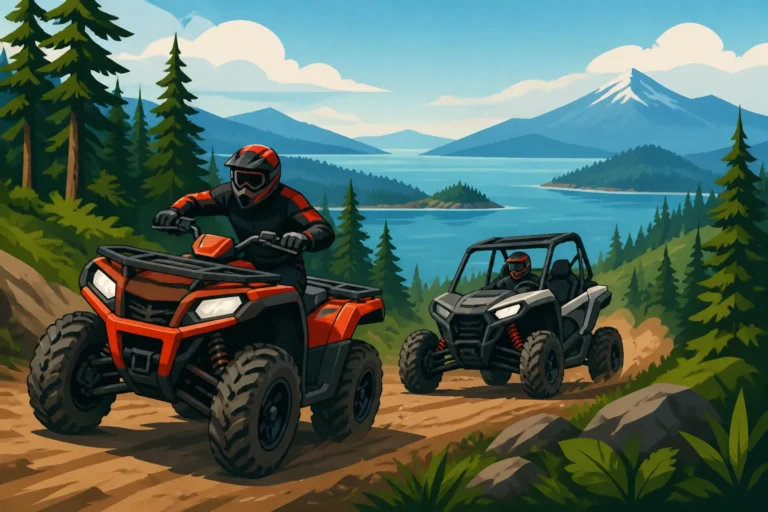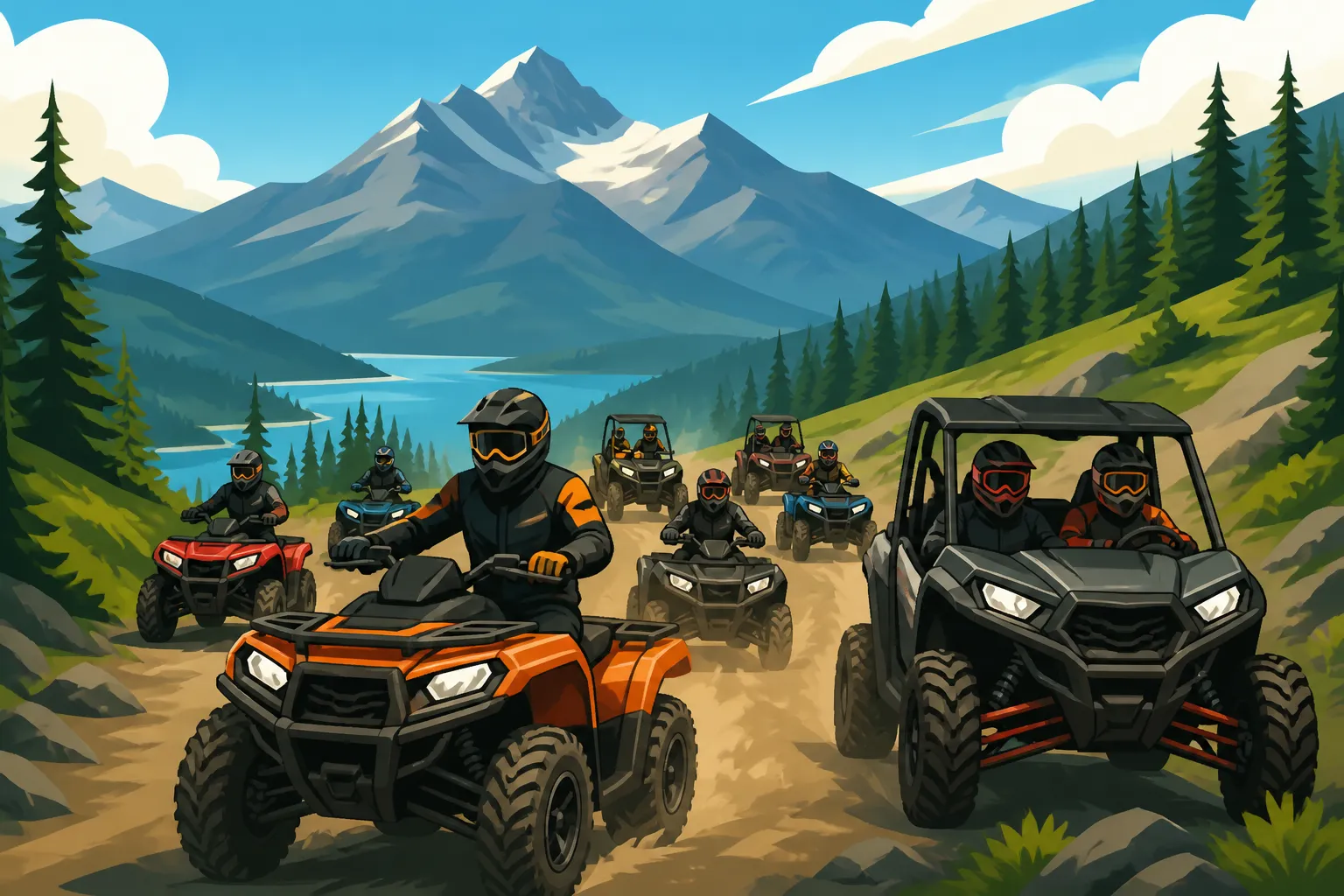
BC Riding With a Group of Ten
A ride with ten ATVs or UTVs can turn a quiet trail day into a logistical headache: the group gets stretched out, riders miss turns, and a small staging area fills before everyone unloads. This guide explains how to plan a ten-person ride in British Columbia, choose a manageable route, communicate safely, and keep the day enjoyable without leaving anyone behind.
Plan the group before choosing the trail
Decide what “a group of ten” means
Ten people do not always mean ten machines. You might have ten riders spread across six quads and a side-by-side, or ten separate vehicles with a mix of drivers and passengers. That difference affects parking, trail width, fuel planning, communication, and how long it takes everyone to get moving.
Before you settle on a destination, ask who is coming, what they are riding, and how experienced they are. Find out whether anyone is new to off-road riding, has limited mobility, is bringing a child passenger, or prefers to avoid steep, narrow, or technical terrain. A route that feels easy to one experienced rider can be stressful for a beginner, especially when the group behind them is waiting.
Set expectations in advance, too. Agree on the meeting time, the likely length of the ride, the type of terrain, and a realistic turnaround time. If someone expects a relaxed outing and another rider expects to cover as much ground as possible, that mismatch can cause friction before the first trail junction. A clear plan helps everyone arrive knowing what the day is meant to be.
For a fuller planning checklist, see [BC Group Ride Planning]. It is especially useful to assign a ride leader and a designated sweep rider before you leave the staging area. The leader manages route decisions; the sweep stays behind the last rider and confirms that nobody is stranded or separated.
Pick a route for the least experienced rider
A ten-person group is usually more enjoyable when the route suits its least experienced or least confident rider, rather than its most adventurous one. A demanding climb, narrow sidehill, or muddy section can create a long queue and pressure someone to attempt terrain they would otherwise avoid. Choosing a route with options to turn back or take an easier line gives the group room to adjust.
Check the route’s difficulty, length, elevation changes, surface, and likely conditions. A trail that was comfortable in dry weather may become slick after rain or snowmelt. A long route can also become a problem if the slowest rider needs frequent breaks or if the group spends more time regrouping than riding. Build in extra time for stops, mechanical issues, and route decisions.
Use current local information, posted signs, and reliable maps together. A mapping app such as onX Offroad can help riders compare route notes and keep track of the planned route, but don’t treat a map line as proof that a road or trail is open to motorized use. Check for closures and restrictions before setting out, and be prepared to change plans when you reach a gate, notice, or sign you weren’t expecting. [BC ATV Trail Map Downloads] offers another useful starting point for researching possible riding areas.
Confirm the destination can handle ten machines
A riding area that works well for a couple of friends may not work for ten vehicles. Look into the staging area’s parking layout, access road, unloading space, toilets, and any posted rules or pass requirements. Consider whether a trailer convoy can turn around without blocking other visitors or creating a hazard for traffic.
Areas such as Bear Creek near West Kelowna, Chilliwack-area riding locations, and Tabor Mountain near Prince George may come up while you’re comparing BC destinations. Don’t assume that every trail or staging area in a region has the same access, capacity, or rules. Check the specific site and route your group plans to use. The list of [BC Riding Areas With Group Space] can help you focus on the practical question of where a larger party can gather.
If you cannot confirm that a staging area can accommodate your group, consider meeting elsewhere and arriving in smaller waves, or choosing a different destination. Avoid occupying multiple spaces for long periods while people unload, block gates, or parking across access routes. A group of ten is noticeable; considerate staging helps keep the area welcoming for everyone.
Keep the group together without creating a traffic jam
Use a leader, a sweep, and clear regrouping points
A leader at the front and a sweep rider at the back are a simple way to reduce confusion. The leader should know the intended route and be willing to slow down or stop when the group stretches out. The sweep should know who is riding and what each machine looks like, so they can recognize if someone has dropped out of sight.
Agree on what riders should do if they reach a junction and cannot see the person ahead. One common approach is to wait in a safe spot before the turn until the next rider confirms the direction, rather than allowing everyone to guess. Choose regrouping points where machines can pull completely off the travel line without blocking other users.
This system only works if the leader and sweep communicate. If the sweep reports a problem, the leader should stop at the next safe location rather than continuing farther down the trail. For a group of ten, the gap between the first and last machines can grow quickly on winding trails, so stopping periodically is more reliable than assuming everyone is still close behind.
Set simple communication rules
Before the ride, choose a method for communicating: radios, phone calls or messages where service is available, or a clear sequence of hand signals and planned stops. Make sure everyone understands the method. If some riders use radios and others do not, the group needs a backup plan that works for everybody.
On a Forest Service road, industrial traffic may be present, and road-use practices matter. Review [BC Resource Road Radio Practice] before riding where resource-road communication is relevant. Follow posted instructions, use the appropriate channel when required, and never let a group conversation distract from watching the road. If you are unsure about a road’s requirements, check locally before the ride.
Cell coverage can be limited in many riding areas, so don’t make a phone the only way to manage the group. Riders can save route information for offline use where their mapping app supports it. For example, onX Offroad may help individuals keep a route reference when coverage drops, but every rider should still know the next agreed meeting point and what to do if separated. Check the app and map settings before leaving service, rather than discovering at a junction that a needed map has not been saved.
Ride at a pace that leaves room for everyone
A large group should ride at a pace that allows people to maintain control and react to changing terrain. Avoid pressuring a less experienced rider to keep up with faster machines. If the group keeps stretching out, shorten the distance between regrouping points or split into smaller riding groups with separate leaders and sweeps.
Passing deserves special care. Don’t assume that a rider ahead has seen you, and don’t squeeze past on a blind corner, narrow trail, or steep section. Give people room to choose their line and stop safely. At a junction or obstacle, leave space for other trail users to pass rather than forming a wall of machines across the route.
Trail etiquette helps a group of ten avoid making a poor impression on other riders, hikers, or nearby residents. Keep noise and dust in mind, yield appropriately, and avoid spinning tires or widening the trail to get around a difficult spot. [BC Trail Etiquette Locals Expect] is a helpful reminder that good group habits matter even when the group is having fun. You can also review [BC Trail Difficulty Ratings] when choosing a route that suits mixed abilities.
Prepare for BC conditions, rules, and interruptions
Check access, closures, and local requirements
A route appearing on a map does not guarantee it is open to ORVs. Access can depend on the road, land status, signs, seasonal conditions, and site-specific rules. Before the ride, check for closures and restrictions affecting the exact roads and trails you plan to use. If you find a gate or posted restriction on the day, don’t treat it as an invitation to find a way around it.
This is particularly important after wind, heavy rain, wildfire activity, or other disruptions. A road may be damaged, blocked, or unsafe even when the broader riding area remains open. Review [BC Trail Closures After a Storm] and check local notices shortly before departure. Have a backup route or destination so the group can adapt without arguing at a blocked access point.
Registration, insurance, equipment, and riding rules can depend on where you are riding and what kind of road you use. Make sure each rider understands the requirements that apply to their machine and planned route. If the group expects to ride on a Forest Service road, confirm the road-specific requirements rather than assuming that rules for a trail or other Crown land apply in exactly the same way.
Carry the basics and check every machine
A ten-person ride can be slowed by one avoidable issue, such as a loose battery connection, low tire pressure, or an empty fuel tank. Ask each rider to inspect their machine before the trip and bring the supplies appropriate for their own vehicle. A basic check should include tires, brakes, lights, fuel, controls, and visible damage. For side-by-sides, make sure seat belts and other required equipment are in working order.
The group should also agree on shared essentials, without assuming that one person will carry everything. Useful items may include a first-aid kit, tools suited to the machines, tire-repair supplies, water, food, a flashlight, and a way to contact help if a phone has no service. The exact list depends on the route, season, and distance from assistance. If the ride is remote, plan for a delay rather than assuming everyone will be back before dark.
Check helmets and other safety gear before leaving the staging area. Riders should have suitable clothing for the weather and terrain, including layers for conditions that can change during the day. A warm afternoon in the valley does not guarantee warm conditions higher up, and rain can make a long ride uncomfortable quickly. Take time to check on the group’s readiness instead of rushing through the departure.
Make a plan for breakdowns and emergencies
Talk through what the group will do if a machine breaks down or a rider is injured. Decide who stays with the person needing help, who contacts emergency services if possible, and how the rest of the group will remain together. Don’t send an inexperienced rider off alone to find assistance, especially in an area with confusing junctions or limited coverage.
For a breakdown, move machines out of the travel line if it is safe to do so. The leader should stop the group at a safe place and avoid sending riders back and forth through traffic or along a narrow trail. If a machine cannot be repaired, decide whether the rider can be safely transported with another vehicle, whether the rest of the group should wait, or whether outside help is needed. The right choice depends on the location, weather, daylight, and the rider’s condition.
If an incident happens on Crown land, understand how to get help and what reporting steps may apply. [BC Accident Reporting on Crown Land] can help you prepare before an emergency, rather than trying to learn the process while stressed and far from a town. Make sure someone outside the group knows your general destination and expected return time, particularly if the route has limited cell service. A shared route plan is useful only if someone knows where to look when the group does not check in.
A practical ride plan for ten people
Use a pre-ride checklist
A checklist keeps small details from becoming last-minute problems. Share it with the group several days ahead, then confirm the important points again before unloading. People are more likely to arrive prepared when they know exactly what is expected.
| Planning item | What to confirm |
|---|---|
| Riders and machines | Names, machine types, passengers, experience levels, and emergency contact |
| Route and backup | Intended route, alternate route, turnaround point, and expected ride duration |
| Access and rules | Current closures, posted restrictions, registration, insurance, and site requirements |
| Communication | Leader, sweep, radio or phone plan, hand signals, and regrouping points |
| Staging | Parking, trailer space, unloading area, and a meeting point that does not block access |
| Equipment | Fuel, machine checks, helmets, weather-appropriate clothing, water, and basic tools |
| Emergency plan | Breakdown response, emergency contact method, and check-in time with someone outside the ride |
For a large group, assigning tasks makes the plan easier to carry out. One person can confirm access and closures; another can coordinate arrival times; the leader can handle navigation; and the sweep can check that the last rider is accounted for. If one person tries to manage every detail, important tasks can fall through the cracks.
You may also want to share the planned route using a mapping app such as onX Offroad, as long as everyone understands that shared route information is a navigation aid, not a substitute for checking access or watching for signs. Ask riders to download or save what they need before leaving reliable service, and agree on how the group will respond if the planned track differs from conditions on the ground.
Consider splitting into smaller riding groups
If the group includes riders with very different speeds or skill levels, splitting into smaller groups can improve the experience. Each group should have its own leader and sweep, a clear route, and an agreed meeting time and location. Do not split informally at a junction and assume everyone will find the same route back.
Smaller groups can reduce congestion on narrow trails and make it easier to maintain safe spacing. They can also give beginners more room to ask questions and ride at a comfortable pace. The trade-off is that each subgroup needs to be self-sufficient and able to follow its own plan if the groups do not meet exactly on schedule.
Before the ride, decide whether the groups will stay within radio or phone contact, follow separate loops, or meet at fixed points. If reception is unreliable, use obvious landmarks and realistic return times. A route plan in onX Offroad or another map can help riders stay oriented, but the group still needs a straightforward fallback: where to wait, whom to contact, and when to return to the staging area.
A group of ten can make for a memorable BC riding day when the logistics are handled before the engines start. Choose a route everyone can enjoy, check access and conditions, communicate clearly, and give riders room to ride within their abilities. That preparation leaves more attention for the scenery, the trail, and the people you came to ride with.
Disclaimer
This article is for general informational purposes only and does not constitute professional advice. Laws, prices and regulations vary by location and change over time. Consult a qualified professional for guidance on your specific situation.