Declaring Ownership Under Oath
It's a common story in British Columbia: you've got this great off-road vehicle – maybe it's a quad you bought years ago, a side-by-side inherited from a family member, or a dirt bike you picked up from a private seller who's now vanished into thin air. The problem? You don't have a tidy paper trail for its ownership. This guide is here to walk you through how a statutory declaration of ownership can be your saving grace, allowing you to legally register your machine with ICBC and ride worry-free on BC's incredible trails and resource roads.
Why You Might Need to Declare Ownership Under Oath in BC
Let's be honest, not every ATV or UTV changes hands with a crisp, notarized bill of sale and a full history of its previous owners. Especially with older machines, or those that have been passed down through generations, the original paperwork can simply get lost to time, forgotten in a dusty shoebox, or just never existed in the first place beyond a handshake and a cash payment. This creates a real headache when you try to do the right thing and get your machine registered. BC's off-road vehicle registration system relies heavily on proving a clear "continuity of ownership," and if there's a gap in that chain, you're going to hit a wall.
Imagine you've just acquired a vintage quad, perhaps from a barn find or an estate sale. The machine itself is a beauty, runs like a top, but the previous owner, bless their heart, never kept records. Or maybe you're in the situation where you bought a used dirt bike, got a handwritten receipt, but now the seller is unreachable, and you realize that handwritten note isn't quite enough for the folks at ICBC. These are the exact moments when the lack of proper documentation becomes a major stumbling block. The provincial rules want to see a clear line of who owned it, when, and how it transferred to the next person, all the way up to you. This is crucial for establishing legitimate ownership and preventing the registration of stolen property. Without a comprehensive paper trail, your path to legal registration can seem impossible. This is where a formal declaration steps in, providing a legal affidavit to bridge that missing information.
The challenge is further compounded by the fact that [Why BC Does Not Title an ATV]. Unlike cars, which have titles that serve as a definitive proof of ownership, off-road vehicles in BC receive a Certificate of Registration. This certificate isn't a title in the traditional sense; it simply registers the operation of the machine and identifies the person responsible for it. To get that certificate, you need to prove how you came to possess the vehicle. Without a clean [BC Ownership Chains Going Back Decades], even if you're the rightful owner, the system can't proceed. Brokers need those [BC Bills of Sale for Every Prior Owner] to ensure everything is above board. If you're struggling to register an older machine due to missing papers, a statutory declaration is often the only way forward. [BC Registration When the Seller Has No Papers] is a very common problem, and this is the solution.
What is a Statutory Declaration of Ownership and How Does It Work?
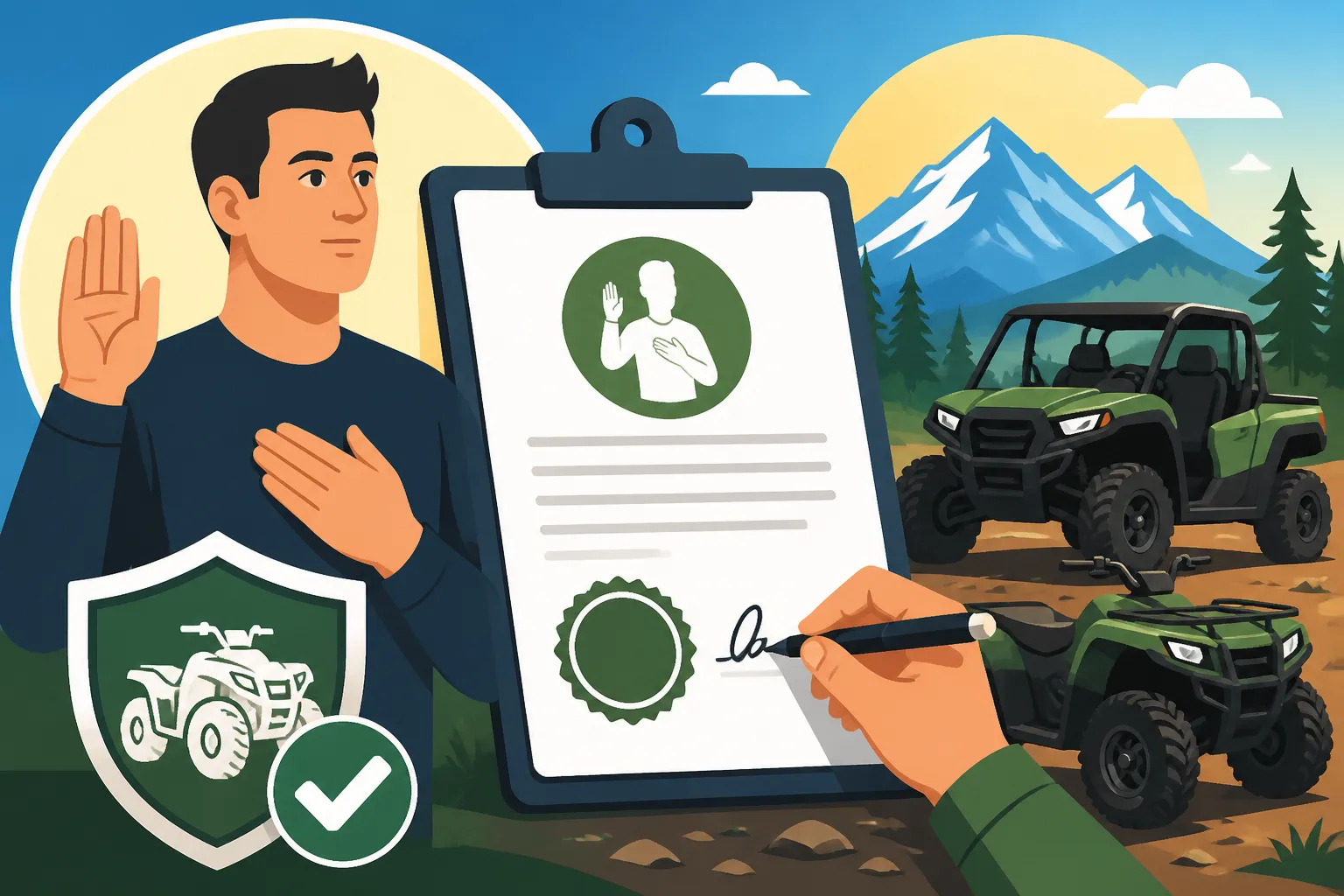
A statutory declaration of ownership is a formal, legal document where you solemnly declare, under oath or affirmation, that you are the lawful owner of an off-road vehicle and provide details about how you acquired it. It's essentially a sworn statement of facts, made in writing, and witnessed by an authorized official known as a Commissioner for Taking Affidavits (which includes Notaries Public and lawyers). The key here is the "under oath" part – you are attesting to the truth of the contents, and making a false declaration can carry serious legal consequences, including fines or imprisonment, which underscores its legal weight.
This document serves as a powerful substitute for missing bills of sale or other traditional ownership documents. When you present a properly executed statutory declaration to an Autoplan broker, you are providing a legally recognized statement that explains your ownership history. It tells the story of how the machine came into your possession, why you don't have the standard paperwork, and affirms your legitimate claim to the vehicle. For example, if you inherited a quad from your grandfather, but he never kept a bill of sale, your declaration would state this fact, along with the date of acquisition and that you are now the rightful owner. It becomes a foundational piece of evidence in lieu of what's missing, allowing the registration process to move forward. This formal approach is precisely what's needed when you're navigating [BC Registration Without a Bill of Sale].
Think of it as filling in the blanks in the ownership history. The declaration will typically include your full legal name and address, a detailed description of the off-road vehicle (including its VIN, make, model, and year), the date and circumstances of how you acquired it (e.g., purchased for cash, gifted, inherited), and a clear statement that you are the sole and legitimate owner. It also includes a section explaining why you don't have the original supporting documents. For instance, you might state that the original owner passed away, or that the private seller could not be located after the sale. It’s a serious document, and you want to ensure it's drafted correctly. Many people find templates helpful to ensure all the necessary legal language is included. Resources like LawDepot offer templates for various legal documents, including statutory declarations, which can be a good starting point to ensure you cover all the required points accurately. A well-prepared [BC Statutory Declaration for an ORV] is your best bet when faced with a missing paper trail.
Step-by-Step: Preparing Your Statutory Declaration for BC ORV Registration
Navigating the process of creating a statutory declaration might seem a bit daunting, but breaking it down into manageable steps makes it much clearer. The goal is to provide a complete, honest, and legally sound account of your machine's ownership history.
Gathering Your Information
Before you even start writing, you need to collect all the pertinent details about your off-road vehicle and its journey into your hands. This is the foundation of your declaration. First and foremost, you need the vehicle identification number (VIN). This is absolutely critical. Take a clear photograph of the VIN plate on your machine, noting its exact location. Record the make, model, and year of the ORV. These details must match the machine perfectly, as they will be central to your sworn statement.
Next, you need to reconstruct the story of how you acquired the machine. This includes the date you took possession, from whom you acquired it (even if it was a non-cash transaction or an inheritance), and the specific circumstances surrounding that acquisition. For example, if you bought it for cash from a private seller at a specific address, try to remember as many details as possible. If it was a gift, from whom, and when? If it was inherited, from what estate? You also need to clearly articulate why you don't have a traditional bill of sale or other prior ownership papers. Was it lost in a move? Did the previous owner never provide one? Was it a casual sale where formal papers weren't exchanged? Be prepared to explain this gap clearly and concisely. Finally, gather any existing documentation you do have, even if it seems informal or incomplete. This could be old registration papers from another province, a cancelled cheque, a partial handwritten receipt, or even an email exchange with the seller. While these might not be enough on their own, they can serve as supporting evidence for your declaration.
Drafting the Declaration
Now it's time to put pen to paper, or fingers to keyboard. Honesty and accuracy are paramount here. Your declaration should be a truthful and detailed account. Start by clearly stating your full legal name, current address, and contact information. Then, provide a comprehensive description of the off-road vehicle, including the VIN, make, model, and year. Double-check these details against your machine – even a single digit wrong in the VIN can cause problems.
Next, detail the history of how you acquired the machine. State the date of acquisition and the name of the person or entity from whom you obtained it. Explain the circumstances of the acquisition – for example, "I purchased this off-road vehicle for cash from [Seller's Name] on [Date] at [Location]." If it was a gift, state that: "This off-road vehicle was gifted to me by [Giver's Name] on [Date] as a personal gift." It’s essential to be as specific as possible. Crucially, you must include a clear explanation for why you lack the standard documentation like a formal bill of sale. For instance, you might write: "No formal bill of sale was provided at the time of purchase, and efforts to contact the seller for one have been unsuccessful." Or, "The original bill of sale was lost during a household move." Finally, explicitly state that you are the sole and lawful owner of the vehicle, that it is not stolen, and that you have the full right to possess and register it. To ensure you don't miss any critical legal phrasing, consider using a reliable template. Websites like LawDepot offer professionally drafted statutory declaration templates that can be customized for your specific situation, helping you create a complete and legally sound document without starting from scratch.
Commissioning the Document
Once you've drafted your statutory declaration, the final step is to have it commissioned. This means you will sign it in the presence of an authorized official who will then witness your signature and add their official stamp or seal. In British Columbia, this official is typically a Notary Public, a lawyer, or a Commissioner for Taking Affidavits. You can often find Commissioners at Service BC centres, although their availability for this specific service might vary, so it's always best to call ahead. Some legal offices also offer this as a standalone service for a reasonable fee. For example, [BC Statutory Declarations Cost $15] in some instances.
When you go to have your document commissioned, you must bring a valid piece of government-issued photo identification (like your driver's licence or passport). You'll also need the completed, but unsigned, statutory declaration. The Commissioner will review the document, confirm your identity, and then ask you to swear or affirm that the contents of the declaration are true to the best of your knowledge and belief. You will then sign the document in their presence, and they will sign and stamp it, making it a legally binding document. It’s a formal process, but it's usually quite quick. The cost for this service can vary depending on who you see; a Notary Public or lawyer might charge a higher fee than a Commissioner at [Service BC and the Declaration], but it's a necessary step to legitimize your declaration.
What Happens After You Have Your Declaration? Registering Your ORV
With your meticulously prepared and commissioned statutory declaration in hand, you're ready to take the crucial next step: registering your off-road vehicle. This journey ends, or rather, begins, at an Autoplan broker's office.
When you head to your local [BC Autoplan Brokers Handle ORV Registration], bring your statutory declaration, along with your valid photo ID, proof of address (like a utility bill), and any other supporting documentation you might have, such as previous informal receipts or photos of the machine. The broker's role is to review all the paperwork and ensure it meets ICBC's requirements for registration. They are looking for a clear and consistent narrative of ownership. Your statutory declaration should now provide that crucial missing link in the ownership chain, satisfying their need for proof of acquisition. [Documents to Bring to a Broker] often include more than just a bill of sale, and your declaration fills that gap.
The broker will carefully examine your declaration, compare the VIN and other details to your machine (or photos of it), and process the registration. Be prepared for them to ask questions if anything is unclear or if they need further clarification on the circumstances you've outlined in your declaration. This is a normal part of the process, as they are essentially acting as gatekeepers to ensure legitimate ownership. If the chain of ownership was particularly complex, even with a robust declaration, there might be a few back-and-forths, but don't get discouraged. With a properly executed declaration, you have a strong legal basis for your claim. This is particularly vital when you're trying to register a quad with a gap in its ownership chain.
Once everything is approved, you will pay the registration fee and receive your [BC's Certificate of Registration Explained] and a unique BC ORV number plate. This certificate is your official proof that your machine is registered to operate in British Columbia. The broker will hand you [What the Broker Hands You After You Register], including your plate and decal, signifying that your ORV is now fully compliant. This means you can finally hit the trails and resource roads legally. Remember, getting to this point often depends on how thoroughly you've prepared your statutory declaration. Leveraging resources like LawDepot for a template can make this initial preparation much smoother, giving you confidence when you walk into the broker's office.
| Document Type | Purpose | When It's Used | Key Information Provided | Required for ICBC? |
|---|---|---|---|---|
| Bill of Sale | Formal record of a sale transaction | When machine is bought/sold between parties | Buyer/seller names, date, price, machine description, VIN | Yes, for new purchases/transfers |
| Statutory Declaration of Ownership | Sworn statement affirming ownership under oath | When original bills of sale/ownership proof are missing | Declarant's name, machine description, VIN, how acquired, reason for missing papers, affirmation of ownership | Yes, as a substitute for missing bills of sale |
Disclaimer
This article is for general informational purposes only and does not constitute professional advice. Laws, prices and regulations vary by location and change over time. Consult a qualified professional for guidance on your specific situation.